Why I Recommend Every Node Beginner Start with a Home Server vs. a Cloud Subscription
First, let me be clear — I don’t dislike VPS or dedicated servers. In fact, I use them when needed, especially for critical tasks, like…
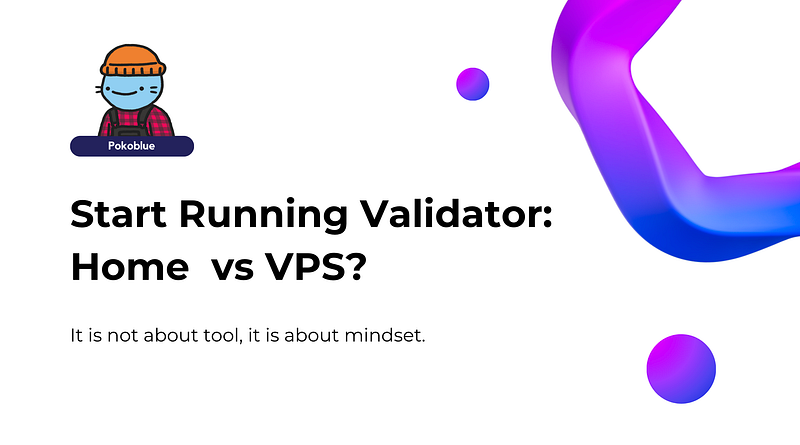
First, let me be clear — I don’t dislike VPS or dedicated servers. In fact, I use them when needed, especially for critical tasks, like when my node becomes active. Running a node at home isn’t necessarily cheaper in the short term, but in the long run, it offers far more value than what you initially invest. The value comes from increased knowledge, hands-on experience, and the deeper understanding gained through managing your own setup.
So, what’s the point of running a node at home?
In my perspective, it comes down to two things:
- Mindset Shift: From Airdrop Hunter to True Validator
- Knowledge & Experience: True Value from Running a Node
Yes, like many others joining a testnet, I expect some Airdrop rewards. But what happens when everyone focuses solely on running a node, keeping it alive, and just copying and pasting commands from various guides? It creates a red ocean similar to social media quests. The real question is: Are we just advanced airdrop hunters who can execute commands on Linux, or do we aspire to become true validators who understand and contribute meaningfully?
What or Who is Validator?
In my view, a validator is someone who truly contributes to the network, not just from an infrastructure or distributed computing standpoint, but also “mentally”. It’s about understanding the architecture, providing meaningful feedback, and going beyond the surface level.
I once watched an interview with a solo Ethereum validator on YouTube. He wasn’t just a user who could keep his node running; he knew every configuration, every error log, and every on-chain event. He understood everything from the inside out, and more importantly, he could provide valuable feedback to the developers on how to improve the network and suggest features that were needed.
This inspired me to think about what it truly means to be a validator. It’s not about simply following guides or expecting rewards — it’s about being a part of the network’s growth. Validators who engage deeply with the technology are the ones who help push the ecosystem forward.
I know I’m not there yet, but he’s my North Star — a model of what it means to be a validator who goes beyond running a node for rewards. It’s about immersion, learning, and contributing to the future of decentralized networks.
My 1st Validator Setup
Reflecting on my personal experience, I still remember the feeling when I first ran a validator on a VPS. (It was Fuel Network Node). Like many others, I started with a VPS. After activating it, I kept waiting to access SSH and began following the guide. At that time, I was a noob, simply copying and pasting commands. Two hours passed, I tried different commands and guides from various influencers, but the node was still not running. I knew there were errors, but I didn’t really understand what they meant. I didn’t even try to understand them.
Two days later, I was still facing the same issues. I was frustrated with the guide, feeling like it just didn’t work for me at all. I felt like the money spent on the VPS was burning away, and I was exhausted and ready to give up. So, I decided to step back and take a break. I walked around my room, trying to think deeply about the root cause. I asked myself questions like: What am I missing? What assumptions am I making that could be wrong? What details have I overlooked?
…It wasn’t about a bad guide — others had proven that it worked for them.
…It wasn’t about the tool or machine, as we were all using similar VPS setups.
… It wasn’t about the OS or environment, as I used a fresh Ubuntu setup.
… Then, what was it?
…It had to be something about me — my mindset. And, the cost of the VPS was a catalyst, clouding my vision and making me lose sight of my North Star.
However, this struggle was also a valuable lesson — it made me realize the importance of truly understanding what I was doing, rather than just blindly copying and pasting. I decided to take things slower, ignoring the cost of the VPS and focusing on understanding every line in the configuration. It took me another week to get it up and running properly, with my block height finally syncing. Looking back, I feel like this experience separates those who simply run nodes for rewards from those who want to be true validators.
My 2nd Validator
Then, I decided to run a second validator, and I found the 0g_lab node. But this time, I chose to run it at home using my gaming computer, which has decent specs. I didn’t expect to run it permanently but just wanted to learn how to set it up and make it work. I also didn’t want to stress about burning money on a second VPS. It was a bit faster, but to be honest, it still took almost two weeks to get it running.
However, one thing I noticed was that I wasn’t rushing this time. I had the opportunity to dive deeper, going beyond the surface to truly understand what I was doing. The experience felt completely different, and I knew it was helping me gain clarity and align with my North Star. From that point on, I always chose to run nodes at home.
Where Am I today?
Now, I am running almost 22 nodes from over 15 projects at home. It started with that gaming computer, and I expanded to utilize every spare computer available. In the end, I ended up with almost 5 physical computers to run the nodes. One of them is my gaming computer. Three of them were my outdate computers, good enough to run 1–2 nodes each. Finally, I decided to invest a server-spec computer (2 CPUs, 128 GB RAM, 1TB NVMe).
Conclusion
To be honest, running a node at home is not easy. You have to manage things that a VPS provider typically handles for you, like disk space expansion, networking, security, VMs, etc., but this forces you to learn new things and shift away from being just an airdrop hunter. I have learned a lot through these experiences. I also have an ariticle where I make it like a placeholder for my journey. Please take a look, and you will understand my journey in the other version.
So, that’s why I encourage everyone to start running a node at home. VPS is a better choice when you have experience, but it can easily blind your vision and be costly. Believe me, if you have a mouse, keyboard, ChatGPT, and any computer at home, you can start running a validator node. I would be more than happy to hear your version of this story. How did your node journey start, and how did you make it successful?
Thank you for reading.